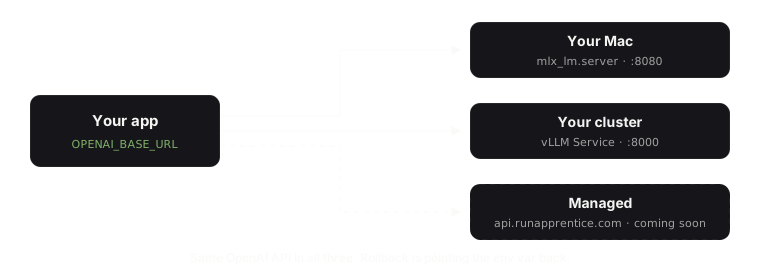
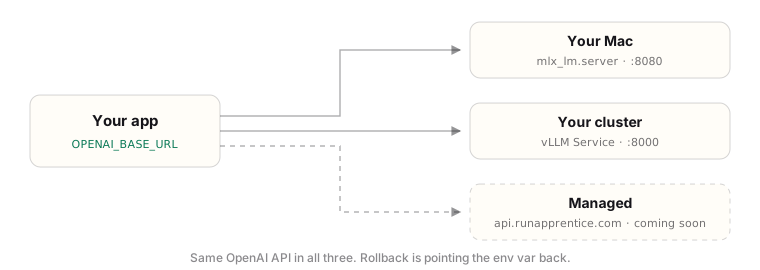
Apple silicon and MLX The local path runs entirely on your Mac. Training uses mlx-lm, Apple’s ML framework for Apple silicon. Your data never leaves the laptop. Your app points OPENAI_BASE_URL at one of three endpoints: your Mac, your cluster, or managed

Prerequisites

  • A Mac with Apple silicon (M-series). Unified memory decides the training memory profile: 16 GB works, more is faster.
  • Python 3.10+ and the SDK: pip install runapprentice
  • A CSV of examples with input,output columns. Rows you pass with --data are treated as gold: no account or review step.

Hand it to your agent

Working in Claude Code, Codex, or Copilot CLI? Install the skill and hand over the whole path:
/plugin marketplace add singhabhishekkk/apprentice-skill
/plugin install apprentice@apprentice
npx skills add singhabhishekkk/apprentice-skill -a codex
npx skills add singhabhishekkk/apprentice-skill -a github-copilot
Then paste:
Using the apprentice skill, set up the local Mac path: train from
golden.csv with `apprentice train extract --local`, then serve the
adapter with mlx_lm.server on port 8080 and point this project's
OPENAI_BASE_URL at it.
The skill guides the commands and checks the run report; you stay in the loop for every step that touches your code. Prefer to run it yourself? The same two steps follow.

Train

apprentice train extract --local --data golden.csv
What happens, in order:
  1. Preflight checks the dataset, model, and memory profile.
  2. mlx_lm lora fine-tunes Qwen/Qwen3.5-4B with a LoRA adapter on your gold rows.
  3. A held-out slice is scored before and after, so the report shows a real delta, not a feeling.
  4. The adapter, its SHA-256, the mlx-lm version, and the scores land in a local run report.
Useful flags:
FlagWhat it does
--effort low|medium|highMemory profile, not a quality knob. Every tier trains the same model on the same examples; higher tiers use a bigger batch and need more memory. Default: auto-detected from unified memory. Hit an OOM? Drop a tier.
--keep-awakeKeeps the Mac awake while training runs. Closing the lid still sleeps.
--freshIgnore saved checkpoints and retrain from scratch. Training resumes from the last checkpoint by default.

Serve

mlx-lm ships an OpenAI-compatible HTTP server. Point it at the base model plus your trained adapter:
mlx_lm.server --model Qwen/Qwen3.5-4B --adapter-path <run-dir>/adapter --port 8080
Then point your existing code at it. Nothing else changes:
export OPENAI_BASE_URL=http://127.0.0.1:8080/v1
LangChain, the OpenAI SDK, and anything else that speaks the OpenAI API keeps working as-is. Rollback is flipping OPENAI_BASE_URL back.

Moving the adapter off the Mac

The adapter on disk is in MLX format. Serving it with vLLM on a GPU box (see Deploy in your Kubernetes cluster) needs a format conversion step that we have not published a verified recipe for yet. Until then, treat the Mac-trained adapter as a Mac-served adapter, or retrain in Colab with the benchmark notebooks, whose adapters are vLLM-ready.